
When gold actually moves, in Myanmar time
Myanmar sits at UTC+6:30, which puts the hours that move gold in the evening and the hours that chop it in the afternoon. If your XAUUSD setups keep stalling, the clock may be the reason rather than the strategy.
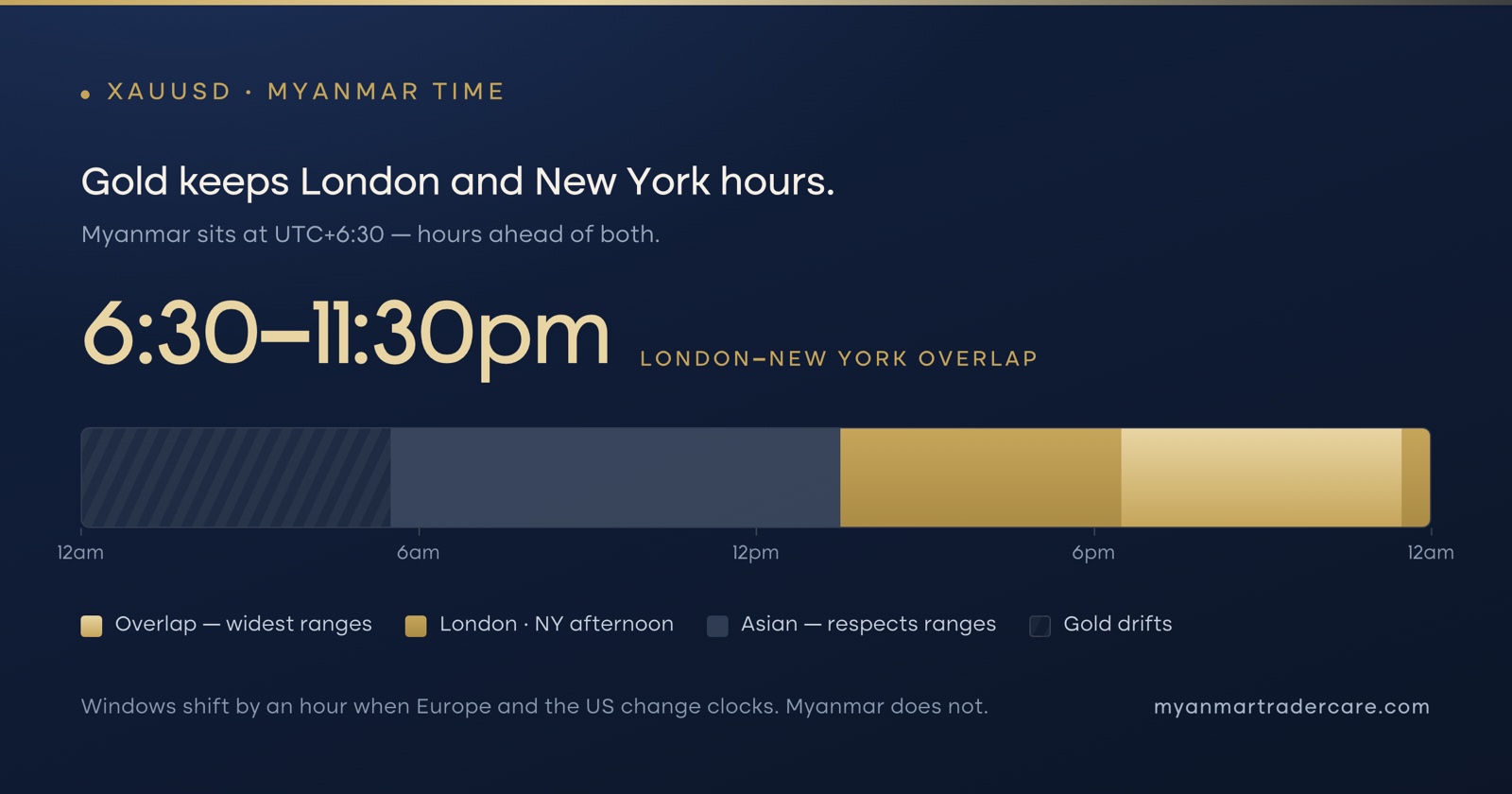
Traders in Myanmar have an awkward relationship with the clock. The market that moves gold is centred on London and New York, and Myanmar sits at UTC+6:30 — hours ahead of both. If you trade XAUUSD after lunch and wonder why every setup stalls, the hour is a more likely culprit than the strategy.
Which hours actually trend
Gold takes its direction from the European and American sessions. Converted into Myanmar time, three windows matter:
- London open, around 1:30pm to 2:30pm MMT. The first real direction of the day usually appears here, and the previous night's range often breaks.
- The London–New York overlap, roughly 6:30pm to 11:30pm MMT. Two of the largest financial centres are open at once. This is where the widest ranges and the tightest spreads live together, which is a rare and useful combination.
- The New York afternoon, after about 11:30pm MMT. Trends already in motion often continue, but with thinner participation as London goes home.
One important caveat: those windows shift by about an hour twice a year, when Europe and the United States move on and off daylight saving. Myanmar does not observe daylight saving, so the change lands entirely on your side of the screen. If your session times seem to have drifted an hour, they have — check the calendar rather than your charts.
Which hours chop
Between the New York close and the Tokyo open, gold drifts. Ranges compress, spreads widen, and stops sit closer than they look on a chart that shows only price. In Myanmar terms, that quiet stretch covers the very early hours and much of the morning.
The Asian session, roughly 5:30am to 2:30pm MMT, is not dead — but it is a different market. It tends to respect ranges rather than break them, so a strategy built on breakouts will produce a lot of false starts if you run it before lunch. Many beginner losses on this pair happen in exactly this window, on setups that would have worked six hours later.
Test it on your own trades, not on our word
This is easy to verify for yourself, and far more convincing when you do:
- Pick two hours from the trending windows above and trade only those for a month.
- Log every entry with the session it fell in — London open, overlap, New York afternoon, or Asian.
- At the end, total your results by session rather than by setup.
Most traders find the pattern in their own log faster than any indicator would show them. It also holds across brokers, so it is a property of the market rather than of where you trade.
Two practical notes
First, check the spread in your window before you rely on it. The overlap generally offers the tightest gold spreads of the day, but "generally" is not "always", and it varies by account type. Our guide to what a trade really costs covers how to read that from your own platform.
Second, respect the news calendar over the clock. A scheduled US release during the overlap can widen a gold spread dramatically for a few minutes. A good hour is not automatically a good minute.
Getting set up
If you are still choosing where to trade gold, our broker directory lists what Myanmar traders use most, and the MT5 login walkthrough shows you where to check contract sizes and spreads once you are in.
Then set your platform's chart to your own time zone before anything else. Trading gold on a chart labelled in someone else's hours is a small, avoidable source of confusion.
Related resources
Continue reading with these related pages.