
What a trade really costs you
The spread is the cost everyone notices. Commission and overnight swap are the two that quietly decide whether a strategy is profitable. Here is how to find all three on your own platform, and how to judge whether they are reasonable.
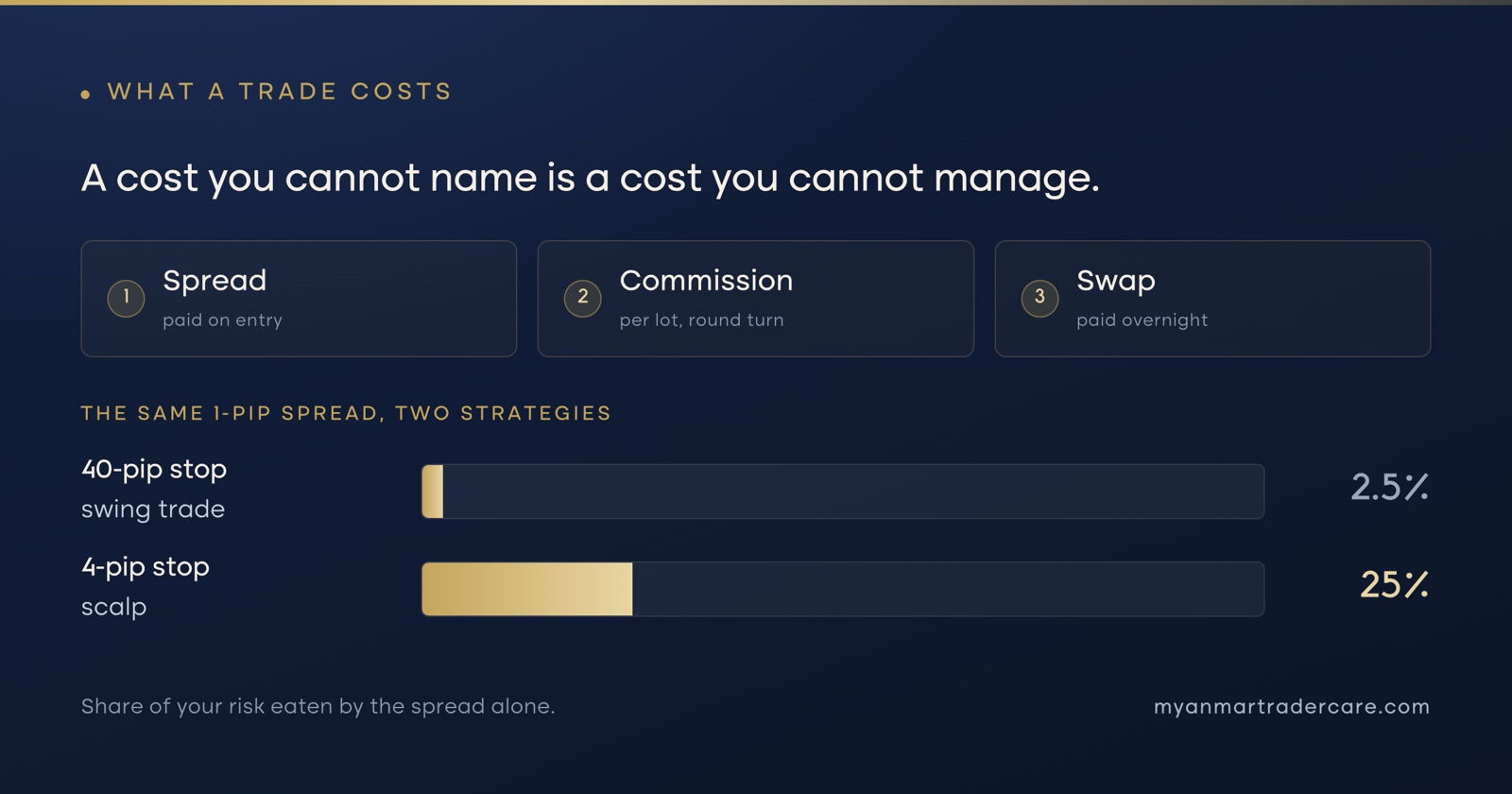
Every trade you place starts slightly behind, and stays slightly behind for as long as you hold it. That is not your broker cheating you — it is the cost of doing business, the same way a shop pays rent. What matters is knowing exactly what you pay, because a cost you cannot name is a cost you cannot manage.
There are three of them, and most beginners only ever look at the first.
1. The spread
Your platform shows two prices: a lower one you can sell at, and a higher one you can buy at. The gap between them is the spread, and you pay it the instant you enter — which is why a position shows a small loss the moment it opens.
The spread on its own tells you very little. What matters is the spread against the trade you are planning:
- A 1-pip spread against a 40-pip stop is 2.5 percent of your risk. Ignorable.
- The same 1-pip spread against a 4-pip scalp is 25 percent of your risk. That strategy needs a different account type, or a different strategy.
- A spread that widens to 6 pips at the moment you want to enter is not a cost. It is a reason to wait.
Spreads are not fixed prices your broker sets each morning. They reflect how many participants are quoting both sides at that instant, which is why they widen predictably: in the minutes around a scheduled news release, in the gap between the New York close and the Tokyo open, and in the first seconds of Monday trading.
2. Commission
Some account types show you a very tight spread and charge a separate commission per lot instead. Neither model is automatically cheaper — they are two ways of quoting the same thing, and the only way to compare is to add them up.
Do the arithmetic on the size you actually trade. On 0.10 lots, a 1.2-pip spread with no commission and a 0.2-pip spread with a 7 USD per lot round-turn commission come out close enough that the difference is noise. On 2 lots, that same comparison can swing meaningfully. Compare at your size, not at the broker's example size.
3. Overnight swap
This is the cost that surprises people, because it appears while you are asleep. Holding a position past the daily rollover means paying or receiving interest on the two currencies involved. It can be a credit, but for retail traders it is more often a debit.
Two things to know:
- Wednesday usually costs triple. Spot forex settles two business days forward, so the Wednesday roll carries the weekend's financing. For FX and metals, that night is charged at three times the normal rate. Brokers move the triple day around market holidays, so check the symbol specification rather than assuming.
- It compounds against long holds. A swap that is trivial overnight is not trivial across three weeks. If your strategy holds positions for days, price your swap into the plan before you enter, not after.
Finding your real numbers
Do not take these from a marketing page. Take them from the platform you actually trade on:
- In MetaTrader, right-click the symbol in Market Watch and open Specification. Spread, contract size, and both swap rates are listed there.
- Watch the spread during your trading hours, not at a random moment. If you trade Myanmar evenings, a spread quoted during the quiet Asian afternoon tells you nothing useful.
- After a week, open your account history and total the commission and swap columns. That number is your real cost of trading, and it is usually larger than people guess.
If you have not opened a platform yet, our MT5 login walkthrough gets you to the screen where these figures live.
What counts as reasonable
Rather than chasing the lowest advertised number, judge a broker on whether its live cost matches its advertised cost during the hours you trade. A broker whose real spread is double its marketing figure in your session has told you something important about itself.
Our broker directory lists the accounts Myanmar traders open most often, and the reviews page carries what other traders have actually experienced. Between the two, you can form a view before you deposit rather than after.
Related resources
Continue reading with these related pages.