
How much should one trade risk?
Most accounts are not lost to bad analysis. They are lost to one trade that was too big. Here is the arithmetic that decides your lot size before you place an order, with a worked example on a 500 USD account.
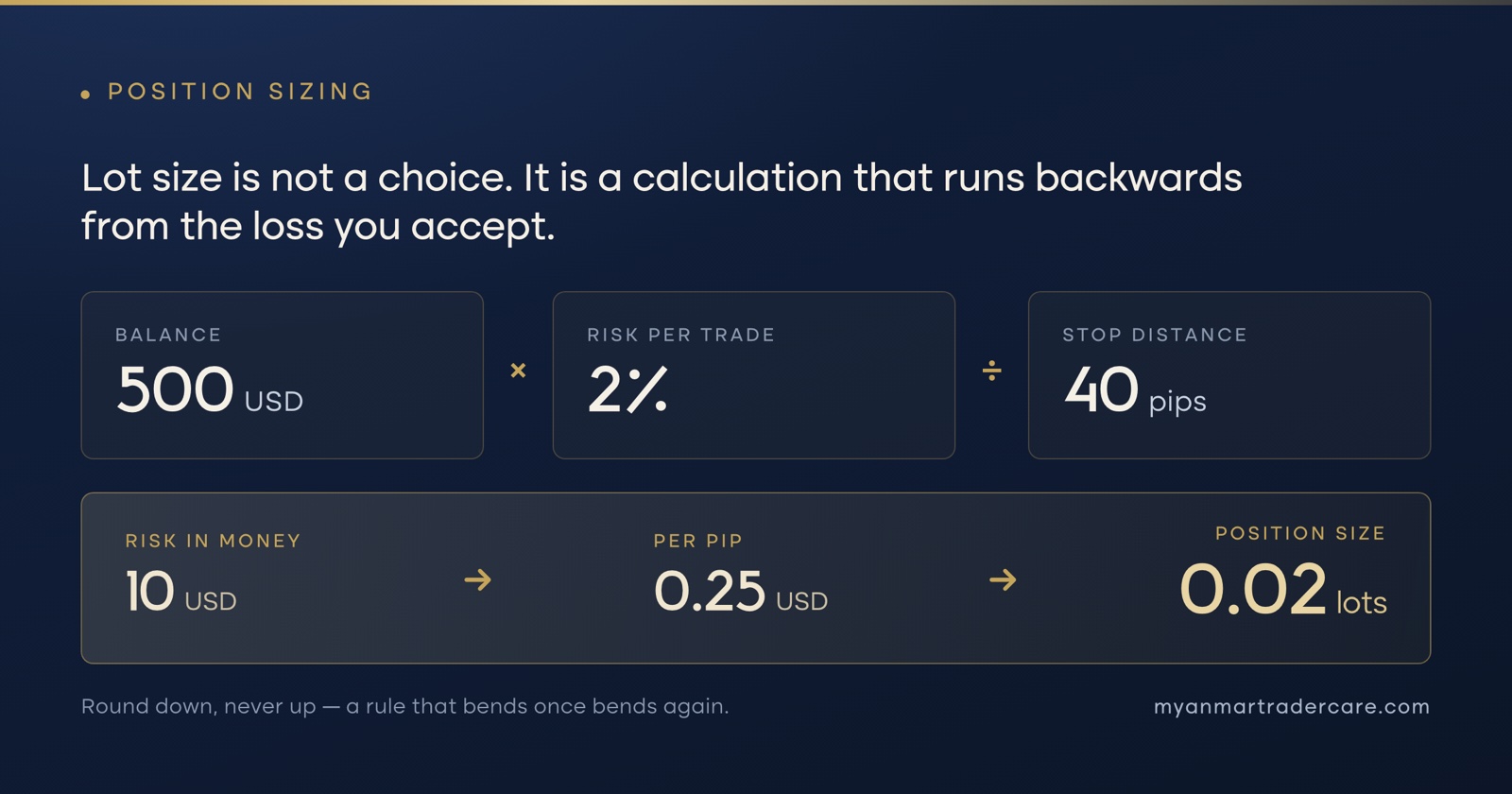
Ask a new trader what they risk on a trade and you usually get an answer about lots: "I trade 0.1." Ask an experienced one and you get an answer about money: "About two percent." That difference is most of what separates an account that survives a bad month from one that does not.
Lot size is not something you choose. It is something you calculate, and the calculation runs backwards from the loss you are willing to take.
Start from the loss, not the lot
Three numbers decide your position size, and only one of them is about the market:
- Your account balance — what you actually have deposited.
- Your risk per trade — the share of that balance you accept losing if this trade is wrong. One to two percent is the common range.
- Your stop distance — how far price must move against you before your idea is proven wrong. This comes from the chart, not from your wallet.
Position size is whatever makes those three agree. Written out:
Position size = (balance × risk %) ÷ (stop distance × value per pip)
A worked example on 500 USD
Say you have 500 USD and you risk 2 percent. That is 10 USD on this trade — not 10 percent of your feelings about the setup, exactly ten dollars.
You want to buy EURUSD, and the level that would prove you wrong sits 40 pips below your entry. On EURUSD, one standard lot is worth about 10 USD per pip, so 0.01 lots is about 0.10 USD per pip.
Ten dollars of risk, divided by 40 pips, gives 0.25 USD per pip. At 0.10 USD per pip for every 0.01 lots, that is 0.025 lots.
Your platform almost certainly trades in steps of 0.01, so you cannot place 0.025. Round down, never up. Trade 0.02 lots, risk 8 USD, and keep the change. Rounding up to 0.03 quietly turns your 2 percent rule into 2.4 percent, and rules that bend once bend again.
The same maths on gold
Gold catches people out because the contract is bigger than it looks. One standard XAUUSD lot is 100 ounces, so a 1 USD move in the gold price is 100 USD on your account. That makes 0.01 lots worth 1 USD per dollar of price movement.
Same 500 USD account, same 10 USD of risk. If your stop sits 3 USD away in gold's price, then 0.01 lots risks 3 USD and 0.03 lots risks 9 USD. So 0.03 is your size — and a "small" 0.10 lots would have risked 30 USD, six percent of the account, on a single trade.
Why one to two percent, and not more
Losing runs are normal, not a sign you are bad at this. What matters is how much of the account a normal losing run consumes.
- At 2 percent per trade, five losses in a row cost you about 10 percent. Uncomfortable, entirely survivable.
- At 10 percent per trade, the same five losses cost you about 40 percent. To get back to even you now need a 67 percent gain, and that pressure is exactly what makes people over-trade.
The trader risking 2 percent is not being timid. They are staying in a position to keep trading their edge long enough for it to matter.
Do it before you click, not after
Work out the size while you are still deciding whether to take the trade. Once the order ticket is open and price is moving, the number you type will be the number that feels right, and what feels right in that moment is almost always too big.
A habit worth building: write the three numbers down — balance, risk in currency, stop distance — before you touch the platform. If you cannot state your stop distance, you do not have a trade yet.
Where to practise this
Every broker in our broker directory supports fractional lots, so this arithmetic works the same wherever you trade. If you have not opened an account yet, our account opening walkthrough covers the setup step by step, and the FAQ answers the questions that come up most often afterwards.
Then trade one week at your calculated size and nothing larger. It is a duller week than most beginners expect, and that is the point.
Related resources
Continue reading with these related pages.